ndrandall
Art of
objects
and
things
Objects speak of themselves and others. When I enter into a relationship with them we are both transformed.
Transformation of an object does not seek to change its integrity rather imbue it with
a sense of otherness.
Nicola Randall
BA (Hon) Fine Art
I work with found objects and materials to create sculpture, assemblages and installations. I have recently returned to art after a near twenty-year break during which I worked as a nurse in the NHS and raised my family. I studied Fine Art at Anglia Ruskin University in 2005 and it was here that I developed a passion for materials and discovered the joys of the readymade and found. In 2023 I picked up where I left off and returned to a project with an old piano. A joyful connection to the individual crafted pieces would reignite a passion and launch me as a contemporary artist. I continue to live and work from my home studio in Cambridge, UK.


The Piano Collection

In 2003 I made three works of art from an old piano I inherited with my house. Known as 'birdcage' pianos due to their over-damper wires which give this appearance, this style of piano was affordable and brought music to ordinary homes. They were completely phased out by the early twentieth century, in part because their damper wires made them difficult to tune and repair. When I first opened up my piano I found lots of little scraps wedged inside which bore evidence of attempts to retune. I made a collage of these named Ode to the Piano Tuner 2003. Destined for the scrapyard, I decided to use the piano as a material to make art. I created The dancer (2003) from the keys and pedals and String theory (2005) from the hammers. After this I put the rest of the piano parts in my loft until years later another birdcage piano came my way. Drawn to their craftmanship, function and role, and inspired by their zoomorphic features, I set about dissecting and cleaning hundreds of pieces. I wanted to let the objects speak for themselves and chose a white background where the pieces could adhere to invisible lines of composition. These compositions are inspired by those found in the languages of words, numbers, music, art, and our bodies. A total of eight designs were selected to complete the collection with further editions made of each

ND Randall, 2003. Piano hammers

ND Randall, 2003. Piano keys and pedals

ND Randall, 2003. Scraps found inside a piano c1900
ND Randall, 2003. Piano hammers

Femme Sonata
N D Randall, 2026.
Piano damper on board, 210mm x 120mm x 35cm
A solo piano damper with its felt pad removed reveals a tiny heeled boot, one of only a handful found amongst many. 'Sonata' means a solo piano piece and here presented alone, the zoomorphic and anthropomorphic form resonates with its own unique character and charm. In this little piece I saw myself, sat composed in a tail coat, ready to play the piano. It is the first readymade selected for the collection and informed how I connected to the material.


Allegro
N D Randall, 2026.
Piano dampers on board. 420mm x 297mm x 75mm
Five dampers with felt pads removed are fixed projecting out from the board. With their horse-like features, the dampers are aligned to create a sense of movement and rhythm. It is evocative of horse-racing or a merry-go-round and the shadows add to the sense of movement and direction. Allegro refers to a fast, lively beat or tempo of around 120-180bpm


Vertebrae in C major
N D Randall, 2026.
Piano wippens on board. 420mm x 297mm x 80mm
The wippens form the backbone of a piano allowing movement from the piano keys and pedals to the strings. Seven wippens to represent seven notes are fixed to form a curve and resemble the cervical vertebrae of the spine. A found cord runs through the wippens connecting them together creating a harmonious piece. Light and shadow adds further form and dimension to the piece.


Language of the Birds
N D Randall, 2026.
Piano hammer butts on board. 297mm x 420mm x 50mm
Ten hammer butts with the hammers removed are composed in a wave formation to evoke movement and melody. Influenced by their bird-like features the composition is a reference to the sounds, songs and body language that birds use to communicate. The articulated parts are posed to give a sense of direction or action, mimicing the small adaptations made to written characters in language.
Dance of the Grand Staff
N D Randall, 2026.
Piano damper wires on board, 420mm x 297mm x 50mm
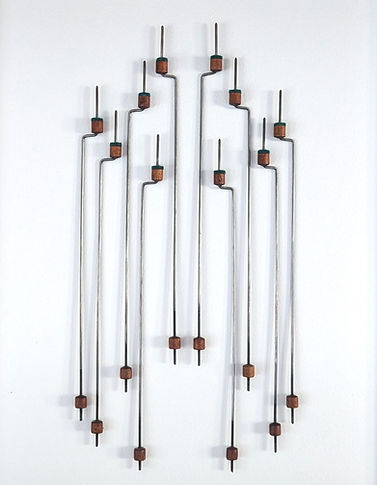
The over-damper wires give name to the 'birdcage' piano from which they come. Ten wires are chosen to represent the Grand Staff; two musical scores of 5 lines and their corresponding spaces joined by a staff. Up-ended and encircling space the beads adhere to an invisible score with the wires capturing a caged form.

Notes Sitting
N D Randall, 2026.
Piano dampers on board, 297mm x 420mm x 50mm
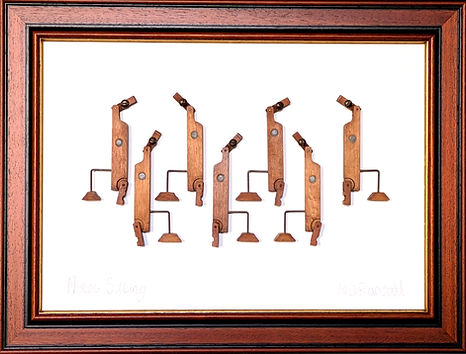
Seven dampers with pads removed are composed in two straight rows. The bodies and heads of the anthropomorphic objects face different directions. The grouping has a sense of interaction and behaviour, and although appearing identical the dampers have varied shoe size which can be observed. Notes Sitting invites you to play spot the difference but also to see a familiarity within this formal arrangement.

End of Eras
N D Randall, 2026.
Piano parts on board, 420mm x 297mm x 50mm
After using all the internal piano parts to make my other compositions I gathered the unused remnants and composed them in a hieroglyphic style. Honouring this early style of language, the forms come together to communicate a story of human craftmanship and engineering. End of Eras reflects on the end of the piano and the 20th century pointing to a new dawn for man and machine.


The Coda
N D Randall, 2025
Piano keys on board. 610mm x 297mm x 55mm
The coda (meaning tail) is a symbol that marks the final notes played at the end of a sonata. The Coda was the last piece made for the collection, using twelve piano keys in numerical order to represent a full scale of notes. The black and white keys are fanned out like a feather revealing the construction of the wooden shafts. It is a fitting farewell to the birdcage piano.

BA (Hon) Fine Art
Anglia Ruskin University 2002-2005
Twist of fate, 2002. N D Randall.
Found filter panel
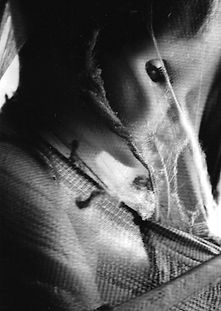
On my very first day at the studio I was drawn to a skip at the back of the college. A framed filter panel coated in a thick layer of dust became my first found readymade object. The corrugated fabric was easily turned into organic creases with a few twists, giving it an uncanny resemblance to flesh. This was the start of my journey exploring the nature of objects and things. I started out with industrial material using sculpture, installation and photography to capture a sense of life. I later began using domestic objects loaded with social and cultural significance to explore human nature. My work during this time explored psychological spaces, using symbolic and metaphoric references found in both the materials chosen and the process. My artwork reflects the horror, humour and beauty that is found in human nature and invites us to reflect on this. My final degree exhibition included bedroom furniture subjected to violence reflecting abuse found within society and the domestic setting.


Standing in
N D Randall, 2002
Easel and dust sheet
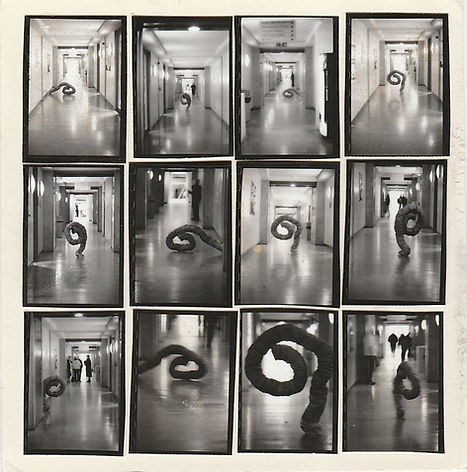
I was inspired by an easel and dust sheet I found in the studio. The looming hidden form created a ghostly figure and had great presence. I took it into a corridor at night and photographed it using 35mm black and white film. The images captured the light and shadows contained within the space adding an eerie atmosphere. Standing centre of the corridor the object confronts the viewer or passer-by who, like the light, must bend round to pass. Here under the sheet the easel appears to be something it is not and has become an actor within an unfolding drama of a corridor.
The cast-off
N D Randall, 2003
Duct, cast, rod and dress
The Cast-off reused a previous piece of artwork using an industrial duct (The cast, 2002). Here the duct was shortened leaving the coiled rod exposed and a crumpled dress hung over to create a head-less human form. The rod extends out of the neck creating a hook and hangs in the air like a giant question mark. This dragged up assemblage refers to the emptiness of being and a disconnection to life. It reveals the discarded hanging onto to a sense of purpose, and installed in an empty room, caught up with place and time.


Within walls
N D Randall, 2003
Vintage wallpaper and flexi-hose.
I found a left-over roll of vintage wallpaper beneath my bath. The dark purple over-sized flowers took me back to my childhood during the seventies where I remember staring at walls covered in patterns. I tore a hole in the paper and using a flexi-hose to give the impression of life inside, I took a series of photographs. In one image the end of the hose pokes through and peers out. Evocative of a wormhole it reminded me how we can time travel through objects and things back to past events and places.


I came, I saw, I conquered
N D Randall, 2004
Boots and mattress
A blood-stained mattress was cut revealing its material layers and a void beneath. Upended, it became a large canvas that filled the wall with the slit eye-level to the observer. Exploring ideas I used a pair of old boots and took photographs. The retro-styled boots, symbolic of women’s liberation and sexual freedom, sit uncomfortably in the background of violence seen in the mattress. The work references the objectification of women's bodies and a journey to reclaim ownership. Only the photographs remain of this work but I would later come to use a mattress again in a piece titled The cut (2005) which was shown during my degree exhibition.
Wrapped up in identity
N D Randall, 2004
Doll and tights.
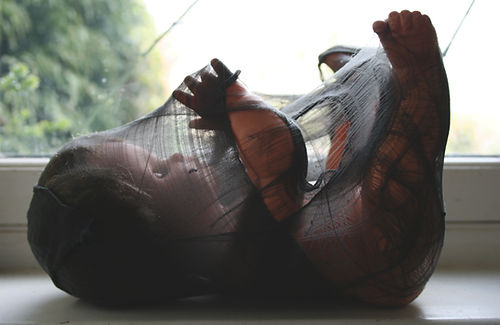
The delicate, torn, nylon tight appears like dark dusty cobwebs and wraps woman and child together in this unsettling material. Photographed on a windowsill adds a sense of neglect and abandonment and an element of fear woven is woven within the distressed fabric. Wrapped up in identity refers to how we identify with ourselves through objects and how childhood experience, culture and society shapes and forms who we are.

Readymade subject
N D Randall, 2004
Book and sawdust
I took an old hardback book off my shelf and sawed it in half. It was only after I realised the title of the book in relation to my actions. The rainforest rich with biodiversity is being cut down, driven by our consumerism. We live in a throw-away society with little respect shown for our environment and things. The destruction of the book is symbolic of this but also of the political act that aims to suppress ideas and values and eradicate cultures. Here the gathered up sawdust is laid between the two halves of the book reflecting the bio/ethnic cleansing committed by nature's most dominant species.
The cut
N D Randall, 2005.
Mattress and bedframe on floorboards.
A mattress is cut and placed behind an upended bed frame and raised on a platform of floorboards. The slit references Luca Fontana's slashes in canvases that created voids and new dimensions for the viewer to enter. The bed is a place for our birth and death, for rest, sleep, sex and dreams. However this canvas filled with domestic significance reveals a darker side referencing abuse and the objectification of women’s bodies. It was displayed at Cambridge Regional College as part of my degree exhibition and stood in the entrance confronting visitors. A small book left for comments reflected a mixed attitude towards the exposed and vulnerable mattress.

Repeated cycle
N D Randall, 2004
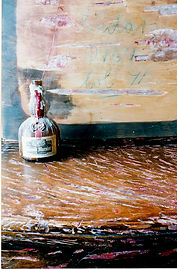
Dressing table with wax and bottle.
Taking a chisel to a dressing table I carved deep gouges into the surface. The act was destructive with the scarred wood baring witness. I used wax to fill in the scars emphasising its wounded nature. The empty bottle, dripped in years of wax, represents time in a repeated process of damage and healing. Installed by a window of an empty room the dressing table with its absent mirror reflects on human nature, in its capacity to tear the self, others, and the world apart, as well as to empathise and care.


Contents remain intact
N D Randall, 2005
Wardrobe and wax.
The wardrobe was subjected to chisels and burning to create a scarred appearance, Wax was then added to create wounded and healing flesh tones. The wardrobe is a symbolic object holding our identities and personalities within. It is a place of transformation but also a place to hide secrets and treasures. The abused surface of the wardrobe reflects mankind’s brutal reactions to identity and otherness. Contents remain intact is in reference to the daily attacks people suffer based on who they are. It was displayed at Cambridge Regional College as part of my degree exhibition.